Clarity Today: news written by software, with the receipts attached
A daily news product where language models write every story, every claim carries its source, and a story that can’t back its own citations doesn’t publish.
- When
- Outside work · I build and run it
- Visit
- theclarity.today
- Sources
- 4 public pages
I build and run it: the LLM pipeline, the caching layer, the schema and the editorial voice.
The problem
Builders, operators and investors get far more news than they can check. Clarity Today tells them what changed, why it matters and what to ignore, across six desks: Security, Build, Invest, Product, Leadership and Science.
It is written by software. Language models draft every article, headline and summary from the reporting they cite, and no one reads each article before it publishes.
So the hard part was never the writing. It was making machine-written news that a reader can check, without a person standing between the model and every story.
Sources: How Clarity Today reads (method), Clarity Evidence Index
What I built
Software does every step: finding reports, grouping the ones that describe the same event, choosing which events become stories, drafting, the claim ledger, the checks, and the order of the front page.
The model that drafts an article also writes each factual claim it makes into a claim ledger, with the source it came from. A story and its ledger commit in the same database transaction, and a dangling citation or an incomplete ledger makes the story ineligible to publish.
After a story publishes, a separate model reads its claims against the other reporting on the same event and records, source by source, whether each one supports a claim, contradicts it or only adds context. Each claim then shows as Supported, Contested or Insufficient, and the check runs again when more reporting arrives.
The aggregate of those ledgers is public as the Evidence Index, with JSON and CSV downloads.
Sources: How Clarity Today reads (method), Clarity Evidence Index
Design tradeoffs
- Under-merge, never over-merge.
- Reports are grouped only when the evidence shows they describe the same event; when that is uncertain, they stay apart. Two stories about one event is a cost a reader can see. One story claiming three sources that are really one is fabricated corroboration, and nobody can see it.
- Fail closed on headlines.
- A second model checks each headline against the claim ledger. A headline the claims don’t support is rewritten once and checked again; if it still fails, or the check can’t run, the story does not publish. A missed story costs less than a headline the facts don’t carry.
- Say insufficient instead of guessing.
- A Perspective Coverage summary needs at least three publishers, and each Reality Strip dimension needs its own evidence links. Below that bar the page says insufficient. A missing measurement stays visibly missing; it is never filled with a made-up score.
- Count publishers, not links.
- “N publishers” counts distinct publishers whose article text the pipeline could read, and leaves out an article that is a near-copy of another. It never counts links or repeats.
- Leave out the number I can’t defend.
- The Evidence Index publishes no publisher count and no source-quality score, because publisher identity coverage isn’t good enough yet to put either in a headline.
Sources: How Clarity Today reads (method), Clarity Evidence Index
What went wrong
The public corrections log has one entry. On October 7, 2026, a story about past.dev said its launch materials gave two different previous-best baselines. The release table carried figures past.dev says were entered in error; its leaderboard and release graphic agree. The story was fixed, with a dated note under its byline saying what changed.
The ledger did its job: the conflict really was in the sources, and the story reported it. What a ledger can’t do is tell a real disagreement from a publisher’s typo. That still took a reader writing in.
Two limits are written into the method. Where the pipeline captured too little of a source’s text, the quotation check can’t confirm a quote. And late corroboration, corrected claims and evidence attached later can revise a past day, so the index is a rolling window, not a lifetime total.
Sources: Clarity Today corrections log, How Clarity Today reads (method), Clarity Evidence Index
What I’d do at 10x
The claim check is the cost that grows fastest, because it reads every claim against every source on the event. At ten times the volume I’d spend first on deciding which claims need the full multi-source read and which can stop at one clear supporting source.
Publisher identity is the next measure to earn. The index leaves out source quality today because the identity data can’t support it; with ten times the sources, that gap becomes the easiest way for weak corroboration to get in.
And corrections can’t wait for readers. The re-check that already runs when new reporting arrives would have to raise a correction candidate for a person, not only change a claim’s state.
Appendix
One story, from its sources to its evidence
Transcript and what each shot shows
- 0:00 Three newsrooms, one story: Starbucks says it isn’t buying Chipotle. On screen: The Sources list of the story’s page: one report each from cbsnews.com, nbcnews.com and qz.com, all dated October 12, 2026.
- 0:04 Clarity groups their reports into one event and writes one story from them. On screen: The story’s head: the Leadership desk, 3 publishers, and the headline “Starbucks rules out buying Chipotle days after the FT reported it had hired advisers.”
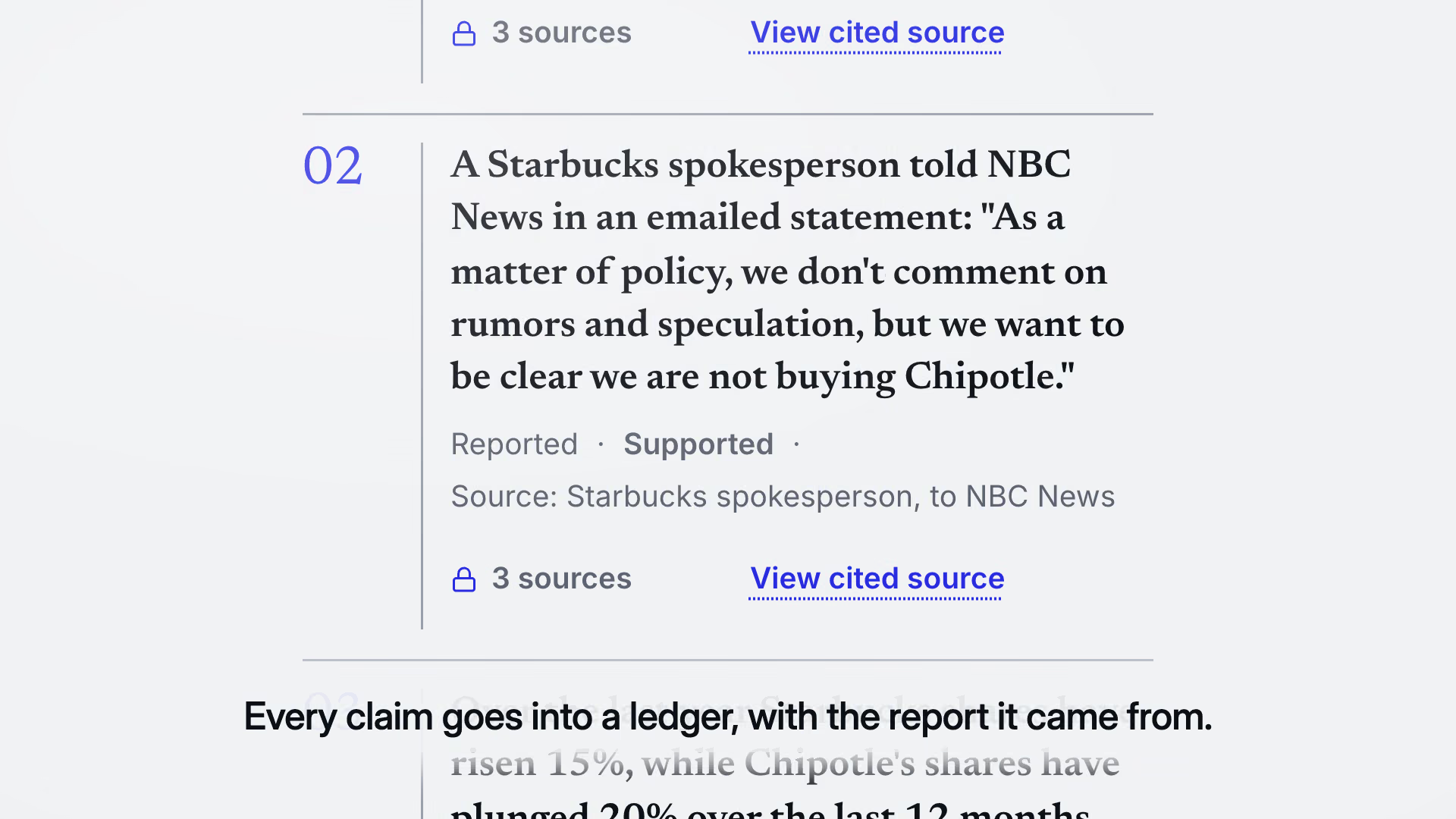
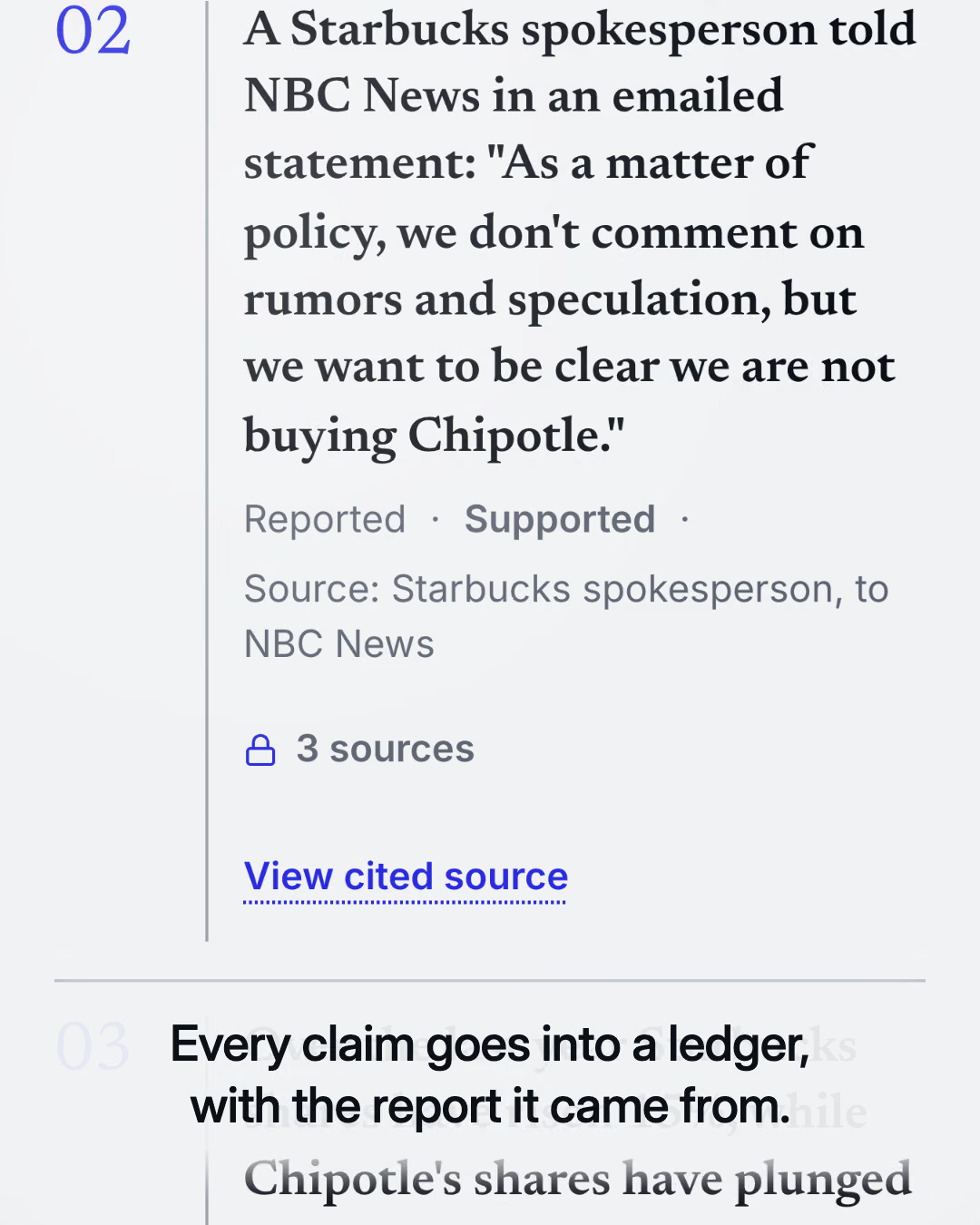
- 0:09 Every claim goes into a ledger, with the report it came from. On screen: The claim ledger, claims 01 to 03, each marked Reported · Supported with its source, such as NBC News or a Starbucks spokesperson.
- 0:15 Each claim carries an evidence state, from supported to insufficient. On screen: The ledger’s filters as captured: All 14, Reported 13, Derived 1, Supported 13, Insufficient 0.
- 0:19 The public Evidence Index, read October 12, 2026: 523,660 claims in 90 days. On screen: The Clarity Evidence Index: 26,562 published articles, 523,660 article claims and 658,619 evidence relationships, source data through 18:20 UTC on October 12, 2026.
By the numbers
| Published articles | 25,837 |
|---|---|
| Article claims | 510,097 |
| Evidence links | 640,946 |